


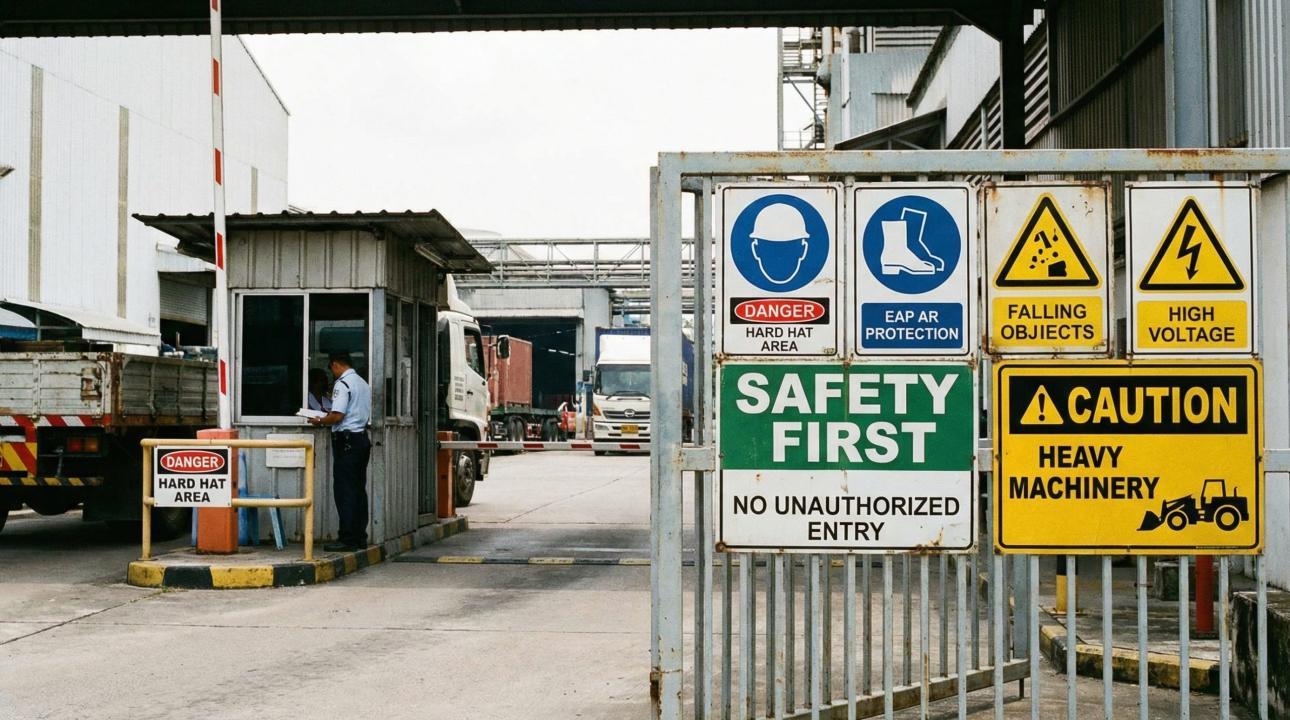
Employers in the UK are legally responsible for providing safety signs in the workplace when risks cannot be avoided or fully controlled by other measures. If that’s news to you, it’s a clear sign to keep reading.
What are safety signs?
Safety signs are clear, recognisable visual graphics used to communicate important health and safety information. They are designed to:
- Warn employees of hazards or dangers
- Provide instructions or required actions
- Indicate mandatory use of Personal Protective Equipment (PPE)
- Prohibit unsafe behaviours
- Highlight emergency exits, fire equipment, and first aid areas
These signs play a critical role in maintaining a safe working environment across all industries.
What does the colour of safety signs mean?
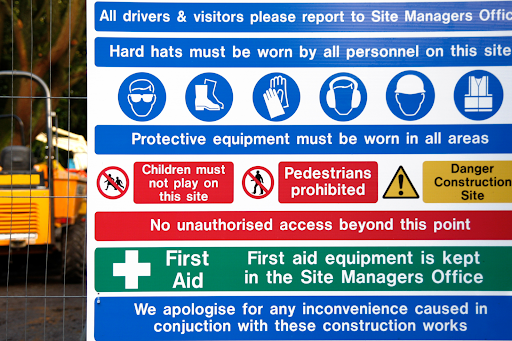
Red safety signs are used as prohibition signage and dangerous behaviour; meaning to stop; shutdown; evacuate.
Yellow / Amber signs are warning signs, meaning to be careful, take precautions or examine.
Blue safety signs mean that a sign is mandatory, and that specific behaviour or action should be carried out, such as wearing protewctive equipment.
Green signs signal an emergency escape or first-aid available. Green safety signs can also be used to label doors, such as exits, escape routes, equipment and facilities.
What are the safety sign usage regulations in the UK?
The expectations that UK lawmakers of UK organisations with regard to the use of safety signage are set out in the Health and Safety Regulations of 1996 (Safety Signs and Signals), which lay out clear rules that employers, duty holders and those in charge of work sites and premises need to follow.
The health and safety regulations state that as well as ensuring that safety signs are provided and maintained, employers are also responsible for ensuring that their employees are aware of and understand the meaning of the safety signs and signals that can be seen or heard during their work.
The best way to determine what signs are necessary is to carry out a risk assessment of the workplace.
Where are safety signs used?
In the workplace, safety signs are commonly found in hazardous areas, such as chemical storage zones or confined spaces, where employees need to be alerted to specific dangers. They are also essential around dangerous machinery and equipment, helping to highlight risks such as moving parts, high voltage, or hot surfaces.
In addition, safety signs must be clearly displayed along exit routes and fire escape paths to ensure safe evacuation during emergencies. Areas where safety equipment is stored, such as fire extinguishers, eyewash stations, first aid kits, and spill kits, should also be clearly marked so they can be quickly located when needed.
What are the 4 types of safety signs?
UK workplaces, safety signage is typically divided into four main categories. These categories are designed to communicate specific instructions quickly and clearly, often using colour and shape for instant recognition.
The four main types of safety signs are:
- Prohibition Signs
- Warning Signs
- Mandatory Signs
- Emergency Signs
The following signs are explained and defined by HSE.
Prohibition sign
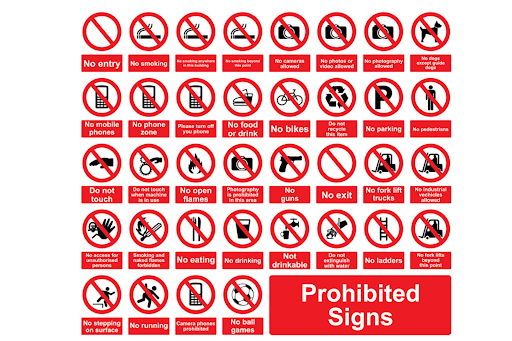
These are signs that prohibit behaviour that is likely to increase or cause danger (eg no smoking).
Intrinsic features:
- round shape
- black pictogram on white background, red edging and diagonal red line (the red part to take up at least 35% of the area of the sign)
Safety warning signs
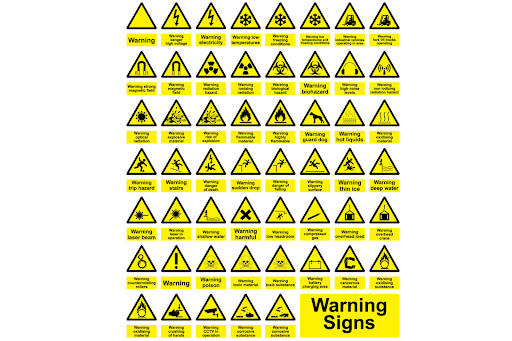
Warning sign - a sign giving warning of a hazard or danger (eg danger: dangerous substances)
Intrinsic features:
- triangular shape
- black picture with at least 50% yellow background
Mandatory signs
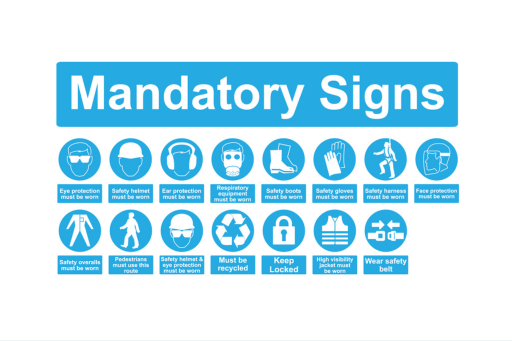
Mandatory sign - a sign prescribing specific behaviour (eg eye protection must be worn)
Intrinsic features:
- round shape
- white pictogram on a blue background (the blue part to take up at least 50% of the area of the sign)
Emergency signs

Emergency Sign - signals an emergency escape or to label escape routes.
Intrinsic features:
- Square shape
- White pictogram on a Green background
Spill kit safety signs

Our range of adhesive spill kit signs are designed to be highly visible and easy to understand, featuring bold text and clear messaging. Manufactured with a durable vinyl coating, these signs are suitable for a variety of workplace environments, offering long-lasting performance even in demanding conditions.
Spill kit safety signs are primarily used to identify the exact location of spill response equipment, ensuring employees can act quickly and effectively during an emergency. They are ideal for use in warehouses, manufacturing facilities, laboratories, and pharmaceutical environments where fast access to spill kits is critical.
Do I need safety signs in my workplace?
To determine if safety signs are necessary for your workplace, you firstly need to conduct a thorough risk assessment (made under the Management of Health and Safety at Work Regulations 1999).
These assessments are designed to identify hazards, the associated risks, and the required measures to be taken. Based on the outcome of the risk assessment, you can determine which types of safety signage must be put up and where.
We’re here to help
If you need more assistance or advice on the type of spill kit safety signs you need? Get in touch with Hyde Park Environmental today.
Straightforward Expertise, Protecting your Reputation.